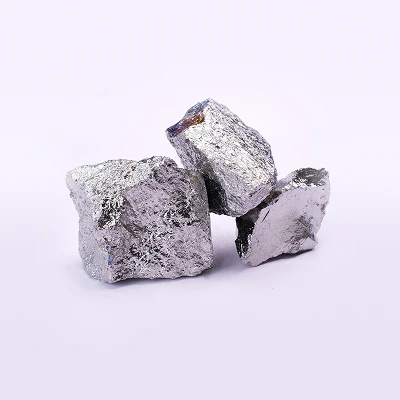

High Carbon Ferro Manganese
Ferromanganese is a ferroalloy with high manganese content (high-carbon ferromanganese can contain as much as 80% Mn by weight).It is made by heating a mixture of the oxides MnO2 and Fe2O3, with carbon (usually as coal and coke) in either a blast furnace or an electric arc furnace-type system, called a submerged arc furnace. The oxides undergo carbothermal reduction in the furnaces, producing the ferromanganese. Ferromanganese is used as a deoxidizer for steel.
A North American standard specification is ASTM A99. The ten grades covered under this specification includes;
Standard ferromanganese
Medium-carbon ferromanganese
Low-carbon ferromanganese
A similar material is a pig iron with high content of manganese, is called spiegeleisen, or specular pig iron.
Production of Ferromanganese:
Ferromanganese is produced through a carbothermal reduction process, where a mixture of manganese dioxide (MnO2) and iron oxide (Fe2O3) is heated with carbon sources like coal and coke.
The reaction occurs in either a blast furnace or a submerged arc furnace, resulting in the formation of ferromanganese.
The manganese content in ferromanganese can vary, with high-carbon ferromanganese containing up to 80% manganese by weight.
Applications in Steel Industry:
Ferromanganese is primarily used as a deoxidizer in the steel-making process, helping to remove impurities and enhance steel quality.
It acts as an alloying agent, contributing to the desired properties of steel such as increased strength, hardness, and resistance to wear and corrosion.
Different grades of ferromanganese (standard, medium-carbon, and low-carbon) cater to specific steel compositions and industrial needs.
ASTM A99 Standard Specification:
ASTM A99 is a widely followed North American standard specification that outlines the various grades of ferromanganese available for industrial use.
The ten grades covered under this specification include standard ferromanganese, medium-carbon ferromanganese, and low-carbon ferromanganese, among others.
This standardization ensures consistency and quality control in the production and application of ferromanganese.
Similar Material: Spiegeleisen (Specular Pig Iron):
Spiegeleisen is another material with a high manganese content used in the steel industry, resembling ferromanganese in some applications.
It plays a crucial role in modifying the properties of iron and steel, contributing to their strength and durability.
While both ferromanganese and spiegeleisen share similarities, they offer unique characteristics, making them suitable for specific metallurgical purposes.
Beyond Steel Industry:
Ferromanganese finds applications beyond the steel industry, including non-ferrous metallurgy, where it acts as a reducing agent for the production of metals like molybdenum and chromium.
The manufacturing of stainless steel relies on the precise control of manganese content in ferromanganese to achieve specific product properties.
Environmental Considerations:
The production of ferromanganese, particularly through traditional methods using carbon sources, leads to carbon dioxide emissions and contributes to greenhouse gas effects.
Ongoing efforts are being made to explore alternative production methods or develop carbon-neutral processes to reduce the environmental impact of ferromanganese production.
Future Outlook:
As technology advances and sustainability concerns grow, there may be further developments in the production and application of ferromanganese.
Researchers and industry experts are likely to focus on optimizing production processes, reducing environmental impact, and exploring new applications for this versatile ferroalloy.
In conclusion, ferromanganese is a crucial component in the steel-making process, offering various grades for different industrial needs. Its applications extend beyond steel to non-ferrous metallurgy and stainless steel production. As sustainability becomes a more significant concern, the industry is actively seeking ways to minimize the environmental impact of ferromanganese production while exploring new possibilities for its utilization.
75 Percent High Carbon Ferro Manganese is used to add distinctive attributes to steel and cast iron for the various constructive applications. Basically, it is an iron alloy which predominately contains high amount manganese in its composition. This alloy is available to us in 10mm to 150 mm of granule size which is of uniform and consistent shape. We have utilized our modern machinery, arc furnace and forging unit to convert iron ore into HC Ferro Manganese.
High carbon ferromanganese (HC FeMn) is an alloy mainly composed of manganese, iron and 2%~8% of carbon.
It is widely used in steelmaking as deoxidizer and alloy additive that enhances the strength and function of steel. It is also used in the production of refined ferromanganese. Our HC FeMn products are produced using EAF.