

How to use Alloy for educational purposes?
Alloy is a remarkable and versatile material that holds significant potential for educational use. As an alloy supplier, I am excited to share with you how alloy can be effectively incorporated into various educational settings to enhance learning experiences and foster a deeper understanding of scientific and engineering concepts.
1. Introduction to Alloy in Education
Alloys are mixtures of two or more metals, often with added non - metallic elements, which exhibit enhanced properties compared to their individual components. In an educational context, alloys can be used to teach a wide range of subjects, from basic chemistry and physics to advanced materials science and engineering.
One of the key advantages of using alloys in education is their real - world relevance. Alloys are ubiquitous in our daily lives, from the aluminum - magnesium alloy in our smartphones to the steel in our buildings. By using alloys in the classroom, students can make connections between theoretical knowledge and practical applications, which can significantly enhance their learning motivation.
2. Chemistry Education with Alloys
In chemistry classes, alloys provide an excellent opportunity to teach students about chemical bonding, atomic structure, and the concept of mixtures. For example, when studying the Aluminium Magnesium Alloy Powder, students can learn about how the different atomic sizes of aluminum and magnesium atoms affect the alloy's structure and properties.
Teachers can conduct simple experiments to demonstrate the formation of alloys. For instance, melting small amounts of pure metals and combining them to form an alloy can help students visualize the process. They can then measure and compare the physical properties of the alloy, such as its melting point, density, and hardness, with those of the pure metals. This hands - on approach allows students to understand the principles of alloy formation and how the properties of an alloy are different from those of its constituent elements.
Moreover, alloys can be used to teach about corrosion and its prevention. Different alloys have varying degrees of corrosion resistance, which is determined by their chemical composition. For example, magnesium alloys are known for their relatively high reactivity, and students can learn about the mechanisms of magnesium corrosion and how alloying elements can be added to improve its corrosion resistance. By studying the MAGNESIUM SHAVINGS and observing their corrosion over time, students can gain a practical understanding of these concepts.
3. Physics Education with Alloys
In physics, alloys play a crucial role in teaching mechanical and thermal properties. Alloys often have superior mechanical properties, such as high strength and ductility, compared to pure metals. For example, steel, an alloy of iron and carbon, is widely used in construction due to its high strength - to - weight ratio.
Teachers can use tensile strength tests on alloy samples to teach students about stress, strain, and Young's modulus. By comparing the results of different alloys, students can understand how the alloy composition affects its mechanical properties. They can also explore the concept of work - hardening, where the strength of an alloy increases as it is deformed.
Thermal properties of alloys are also important topics in physics education. Alloys can have different thermal conductivities and expansion coefficients, which are essential in applications such as heat exchangers and aerospace components. By measuring the thermal conductivity of different alloys, students can learn about the transfer of heat and how it is affected by the alloy's structure and composition.
4. Materials Science and Engineering Education
In more advanced educational settings, such as college - level materials science and engineering courses, alloys are at the core of the curriculum. Alloys are designed and engineered to meet specific performance requirements in various industries.
Students can learn about alloy design principles, such as phase diagrams, which show the relationships between temperature, composition, and the phases present in an alloy. By studying phase diagrams of alloys like the magnesium - aluminum system, students can understand how to control the microstructure and properties of the alloy through heat treatment and alloying.
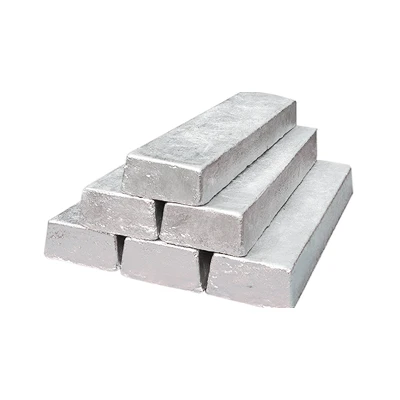

Manufacturing processes of alloys are also important topics. For example, casting, forging, and machining are common methods used to shape alloys into useful components. Students can learn about the advantages and limitations of each process and how they can be optimized for different alloy compositions. The Magnesium Ingot can be used as a starting material to demonstrate these manufacturing processes.
5. Project - Based Learning with Alloys
Project - based learning is an effective approach to using alloys in education. Teachers can assign projects where students are required to design, fabricate, and test an alloy - based product. For example, students could design a lightweight and strong alloy component for a model airplane or a corrosion - resistant alloy container for a chemical experiment.
This type of project allows students to apply their knowledge of chemistry, physics, materials science, and engineering in a real - world context. They will need to conduct research on alloy selection, manufacturing processes, and testing methods. Through teamwork and problem - solving, students can develop critical thinking and practical skills that are highly valued in the industry.
6. Safety Considerations
When using alloys in educational settings, safety is of utmost importance. Some metals and alloys can be toxic if ingested or inhaled, and certain manufacturing processes may involve high temperatures, sharp tools, or hazardous chemicals.
Teachers should provide proper safety training to students before conducting any experiments or projects. This includes wearing appropriate personal protective equipment (PPE), such as safety glasses, gloves, and lab coats. They should also ensure that all equipment and facilities are in good working condition and that proper ventilation is provided when working with alloys.
7. Conclusion and Call to Action
In conclusion, alloys offer a wealth of educational opportunities across different disciplines. Whether it is teaching basic scientific concepts in high school or advanced engineering principles in college, alloys can enhance the learning experience and prepare students for future careers in science and technology.
As an alloy supplier, I am committed to supporting educational institutions in their efforts to incorporate alloys into the curriculum. We offer a wide range of high - quality alloy products, including Aluminium Magnesium Alloy Powder, MAGNESIUM SHAVINGS, and Magnesium Ingot, at competitive prices.
If you are an educator interested in using alloys for educational purposes or would like to discuss potential collaborations, please feel free to reach out. We are here to help you create engaging and effective learning experiences for your students.
References
- Askeland, D. R., & Fulay, P. P. (2011). The Science and Engineering of Materials. Cengage Learning.
- Porter, D. A., & Easterling, K. E. (2004). Phase Transformations in Metals and Alloys. CRC Press.
- Dieter, G. E. (1986). Mechanical Metallurgy. McGraw - Hill.